
Picking the right platform for email and fundraising can feel a bit like standing in a tech store with someone speaking very fast at you. There’s a lot of noise, a lot of options, and most of it isn’t built with nonprofits in mind. So we figured we’d do a deep dive into three platforms you’ve probably already heard of: Constant Contact, Mailchimp, and Funraise, and break down what actually matters when you’re choosing between them.
In this comparison, we’re looking at pricing, core features, integrations, and long-term scalability, all through the lens of what real nonprofit teams deal with day to day. Whether you’re running a lean operation or managing chapters across multiple states, there’s something here for you.
Pricing: Where Every Dollar Counts
For nonprofits operating under $1M in annual revenue, pricing scalability isn’t a nice-to-have. It’s survival. Below is a side-by-side look at what each platform costs at the starting tier and how discounts apply for 501(c)(3) organizations.
| Platform | Starting Price (500 contacts) | Nonprofit Discount | Watch Out For |
|---|---|---|---|
| Funraise | Essentials: $0/mo; Premium: $99/mo (annual) | None needed (fee-based model) | ~90% of donors cover processing fees; total costs stay around 0.8-2.5% of revenue (funraise.org) |
| Constant Contact | Lite: $12/mo; Standard: $35/mo; Premium: $80/mo | 20% off (6-mo prepay) or 30% off (12-mo prepay) | Scales sharply with contacts. Standard at 5K contacts jumps to $110/mo (groupmail.io) |
| Mailchimp | Free (250 contacts, 500 emails/mo); Essentials: ~$13/mo post-discount | 15% off for verified 501(c)(3) orgs | Charges for unsubscribed contacts; free plan significantly limited in 2026 (thenopi.org, mailchimp.com) |
Funraise ties costs to fundraising success rather than list size, which means your platform bill doesn’t punish you for growing your supporter base. Constant Contact and Mailchimp both use per-contact pricing that can quietly catch you off guard at renewal time.
Protip: If you’re considering Mailchimp or Constant Contact, verify your 501(c)(3) status early to unlock discounts right away. But if you want to skip that bureaucracy entirely, Funraise’s free Essentials tier lets you start with zero upfront commitment.
Core Features: Three Philosophies, Three Outcomes
Each platform approaches nonprofit email and engagement differently, and honestly, the philosophy matters as much as the feature list. Here’s how they diverge in practice.
Funraise takes a fundraising-first approach. Its Premium tier includes an integrated CRM and email system where dynamic lists auto-update based on real donor behavior. You also get P2P fundraising, event tools, SMS, auctions, and donation forms that convert at 50% (funraise.org). No manual syncing between systems. No CSV exports at midnight.
Constant Contact is the event specialist. If your nonprofit runs galas, volunteer drives, or ticketed programs, its RSVP management, ticketing, and event automation are hard to beat. A/B testing and segmentation come with the Standard plan, while AI-powered recommendations require Premium (groupmail.io, cazoomi.com).
Mailchimp leads on marketing automation complexity. Advanced branching workflows, multichannel campaigns spanning social and email, and deep audience segmentation make it genuinely powerful for tech-savvy teams. That said, it lacks native event management and its nonprofit-specific features remain limited (cazoomi.com, lovable.dev).
The Struggles We See Every Day
Before nonprofit leaders find the right platform, they tend to hit the same walls. These aren’t edge cases. They’re the daily reality for thousands of organizations running siloed tech stacks.
The spreadsheet bridge. Your donor data lives in one system, your email list in another, and a volunteer maintains a Google Sheet to “sync” them weekly. Except the sheet is three weeks out of date and your year-end appeal just went to 400 lapsed donors with the wrong ask amount.
The surprise invoice. You started Mailchimp’s free tier with 200 contacts. Eighteen months later, your list grew to 4,800 but your monthly bill jumped to $75 and you’re still paying for 300 unsubscribed contacts you can’t quite figure out how to remove.
The integration fatigue. You bolted together Constant Contact, a separate donation form, a CRM, and an event platform. Each tool works fine on its own. Together, they create a fragile chain where one broken Zapier connection means donors fall through the cracks for weeks before anyone notices.
Try This AI Prompt Before You Decide
Comparing platforms can feel overwhelming when you’re also running programs, managing staff, and chasing grants. Copy this prompt into your preferred AI tool (ChatGPT, Gemini, Claude, Perplexity) to get a personalized recommendation in seconds:
I run a [TYPE OF NONPROFIT, e.g., animal rescue] in [STATE/REGION] with approximately [NUMBER] donors and an annual budget of [AMOUNT]. We currently use separate tools for email marketing and donation processing, and we're exploring whether to consolidate into an all-in-one fundraising software for nonprofits like Funraise.org or continue with standalone platforms like Constant Contact or Mailchimp. Based on our size and needs, outline the top 3 factors we should weigh when choosing a platform, including cost projections at our scale, integration complexity, and donor engagement capabilities.
And beyond one-off prompts, it’s worth leaning on solutions like Funraise that have AI components built directly into the platform where you’re already working. That means intelligent donor insights, forecasting, and recommendations with full operational context, not just generic answers disconnected from your actual data.
Integrations and Scalability
Seamless tech stacks prevent the data silos that quietly erode donor relationships over time.
Funraise connects natively with Mailchimp, Constant Contact, Salesforce, QuickBooks, and wealth screening services. It also supports subaccounts for organizations with chapters or affiliates. Organizations using Funraise grow recurring revenue by 52% annually (funraise.org), a number that standalone email platforms simply can’t match because they’re not connected to the giving transaction itself.
Mailchimp offers hundreds of integrations, including Salesforce, but syncing donor and giving data often requires manual exports or middleware tools. It’s powerful, but it asks more of your team.
Constant Contact integrates with Funraise and HubSpot, and its event tools scale well for mid-size organizations. But CRM depth remains limited compared to purpose-built fundraising platforms.
Protip: Look for platforms with BCC parsing capability, available in Funraise Premium. It automatically logs email communications to donor records, saving hours every week that would otherwise go to manual data entry.
“The nonprofits that win in the long run are the ones that stop treating email as a separate channel and start treating it as a natural extension of every donor relationship they manage.”
Funraise CEO Justin Wheeler
Nonprofit-Specific Strengths: A Quick Decision Framework
Rather than a generic feature list, think about which of these sounds most like your organization right now.
“We run 10+ events per year and need rock-solid RSVP and ticketing.” Constant Contact’s 30+ years of event management tools make it a reliable pick. Budget for the Standard plan and prepay annually to lock in that 30% nonprofit discount.
“We’re a small team experimenting with multichannel marketing on a shoestring.” Mailchimp’s automation depth and 15% nonprofit discount can work well here, but watch your contact count carefully and plan for cost jumps as you scale past 2,500 contacts.
“We want fundraising, CRM, email, events, P2P, and SMS in one place without stitching tools together.” Funraise was built for exactly this. P2P fundraisers on the platform raise 2x more than average (funraise.org), and the Essentials plan costs nothing to start.
Protip: Test dynamic segmentation in Funraise, which automatically updates email lists based on giving history and engagement. Nonprofits using behavioral segmentation typically see 20-30% higher open rates without any extra manual work.
Future-Proofing Your 2026 Stack
The trends shaping nonprofit technology right now favor AI-driven personalization, SMS-email hybrid campaigns, and unified donor intelligence. Funraise leads with intelligence dashboards and built-in texting. Constant Contact is adding AI personalization features. Mailchimp continues expanding its multichannel automation. All three are moving in the right direction, just at different speeds and with different priorities.
Here’s the stat worth anchoring your decision to: nonprofits using integrated platforms see 73% annual online giving growth (funraise.org). That’s not a marginal improvement. It’s transformational.
Your mission is too important for a patchwork stack. If you’re evaluating platforms right now, start with the one that lets you test for free with no strings attached. Funraise’s Essentials tier gives you a zero-cost entry point to see whether an all-in-one fundraising platform actually fits your organization before you commit a single dollar.
About the Author

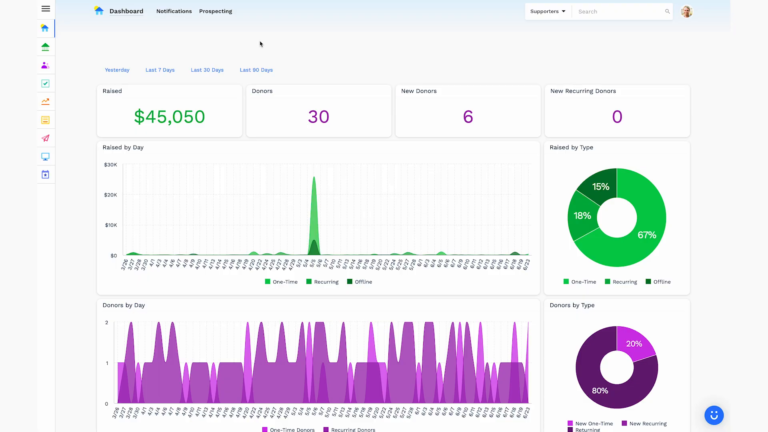
Dashboards for Nonprofits: The 4 Reports Every Team Needs (With Real Examples)
See 4 real nonprofit dashboard examples, from donor retention to sustainer MRR to campaign attribution, plus the KPIs every team should track and how to build your own.

Benefits of Monthly Digital Marketing Maintenance Services for NGOs
Why "Set It and Forget It" No Longer Works Let's be honest. A lot of nonprofits treat digital marketing like a seasonal chore: sprint around GivingTuesday, overhaul the website every few years, refresh the email template only when open rates crater. Sound familiar? The problem is that donor behavior, platform algorithms, and device trends shift…

Fundraising Gala Tech Stack: Auction, Check-In, and Payment Tools Compared
Fundraising galas have come a long way. We're not talking about the old days of paper bid sheets and hand-written guest lists anymore. Today's events run on connected technology that ties together your auction, your check-in flow, and your payment processing into something that actually feels smooth, for your guests and your team. And yet,…