
Fundraising galas have come a long way. We’re not talking about the old days of paper bid sheets and hand-written guest lists anymore. Today’s events run on connected technology that ties together your auction, your check-in flow, and your payment processing into something that actually feels smooth, for your guests and your team. And yet, so many nonprofits are still duct-taping together three different tools that don’t talk to each other and wondering why event night feels chaotic.
So let’s fix that. In this guide, we’re doing a deep dive into the three core pillars of a modern gala tech stack, comparing the leading platforms, walking through the most common failure points we see nonprofits run into, and helping you figure out whether an all-in-one solution or a best-of-breed setup makes more sense for your organization. By the end, you’ll have a clear picture of what to look for, what to avoid, and how to build a setup your team can actually operate with confidence.
Understanding the Three Pillars of Gala Technology
A solid gala tech stack isn’t three separate tools you hope will cooperate. It’s three interconnected systems that pass data to each other automatically, from the moment a ticket is purchased to the thank-you receipt that lands in a donor’s inbox after they’ve gone home.
Here’s how the three pillars break down:
Pillar 1: Auction Management handles mobile bidding, item catalogs, real-time notifications, and the competitive energy that keeps guests engaged and bidding higher.
Pillar 2: Check-In Systems cover guest registration, QR code scanning, table assignments, and attendance tracking, all of which feed into everything else happening that night.
Pillar 3: Payment Processing ensures secure transactions, multiple payment methods, instant receipts, and a checkout flow that doesn’t make your guests want to sneak out before paying.
When these three work together, data flows automatically from ticketing through check-in, into bidding, and out to payment and reporting. That means less manual entry, fewer errors, and a noticeably smoother experience for everyone in the room. When they don’t work together… well, we’ll get to that.
Protip: Before you even start comparing tools, audit your current workflow. Where do you lose data between systems? Where do guests drop off? Where does your team spend the most time on manual tasks the night of the event? That clarity will guide every technology decision you make and help you figure out whether a new tool is actually worth the investment.
Auction Software: The Revenue Engine of Your Gala
Silent auctions remain a staple of nonprofit galas because they’re flexible, scalable, and, done right, generate serious revenue. Mobile-first auction platforms amplify this advantage significantly. According to the 2025 State of Nonprofit Auctions Report, mobile bidding generates around 30% more revenue compared to paper bid sheets (AFP Global, 2025).
And if you’re thinking about younger donors, this matters even more. 65% of Gen Z and Millennial participants value features like outbid notifications via text and AI-powered item suggestions (AFP Global, 2025), which means modern auction tech isn’t just a nice-to-have. It’s how you keep that generation engaged and bidding.
Here’s a look at some of the platforms we see nonprofits using most often:
| Platform | Best For | Key Features | Mobile Bidding |
|---|---|---|---|
| Funraise | Purpose-built nonprofit auctions | Web-based (no app required), secure payment gateway, item catalog, donor management, real-time notifications | No download needed; mobile-responsive |
| Handbid | Maximizing auction revenue | Intuitive mobile interface, paddle raise integration, real-time bid displays, live auctioneer tools | App-based; excellent bidder UX |
| Greater Giving | Hybrid events (in-person + virtual) | Silent + live auction tools, mobile bidding, comprehensive reporting | Mobile app available |
| RallyUp | All-in-one gala management | QR check-ins, live auctions, paddle raises, mobile giving, automated donor receipts | Mobile-responsive web platform |
| CharityAuctions | Virtual, hybrid, or in-person galas | Live bidding, paddle raises, mobile checkout, automated receipts | No app; web-based on any device |
Funraise stands out here because it combines auction functionality with a full nonprofit fundraising platform, meaning your auction data feeds directly into donor profiles for year-round stewardship. You can start free with no commitments to test if it fits your event workflow.
Protip: Require testing before you commit to anything. Set up a test auction with 5 to 10 items and 20 sample bidders. Time the checkout process, note where users get confused, and check how it performs on a phone. A checkout that takes five minutes when it should take sixty seconds is a red flag that will absolutely frustrate donors on event night.
Check-In Technology That Drives Revenue
Here’s something we don’t say enough: check-in is a revenue moment. It’s not just about greeting guests and handing out name tags. Fast, frictionless check-in keeps guests in a good headspace, captures accurate attendance data, and prevents the kind of bottlenecks that slow your entire event flow before it even gets started.
In our experience, the cleanest gala check-in workflows follow a pretty consistent pattern:
- Pre-event: Import your guest list from your CRM or ticketing platform into your check-in software.
- Arrival: Scan the ticket QR code; the system prints a name badge with table assignment.
- During the event: Capture paddle raise donations and auction bids while attendance data syncs in real-time.
- Post-event: All attendance and donation data automatically flows back to your CRM for follow-up.
A few tools that handle this well: Givebutter integrates ticketing, check-in, and donations in one interface. RallyUp feeds QR check-ins directly into live auction data. Donorbox Events offers quick QR scanning with real-time verification. And Nunify brings volunteer and attendance tracking with strong CRM integrations. Each has a slightly different strength, so the right choice really depends on what else is in your stack.
Common Failures We See Before Nonprofits Fix Their Tech Stack
Working with nonprofit leaders every day, we see the same painful scenarios repeat themselves across organizations of every size. Recognizing these patterns is half the battle.
The “Three Spreadsheets” Problem: Your auction data lives in one platform, check-in records in another, and payment confirmations in a third. Post-event reconciliation eats 15-plus hours of your team’s time, and you inevitably lose track of which donors actually paid for their winning bids.
The Night-Of Wi-Fi Disaster: You arrive at the venue, set up your mobile bidding system, and discover the venue’s Wi-Fi can’t handle 200 simultaneous connections. Bidding stalls, guests get frustrated, and you’re scrambling for a hotspot solution while the auctioneer is already mid-presentation. (Yes, this really happens. Often.)
The “Where Did That Donor Go?” Drop-Off: A guest wins three auction items, gets genuinely excited during the paddle raise, pledges $1,000, then quietly disappears because the payment line is twenty people deep. You spend the next two weeks chasing them down, and whatever warm goodwill the event generated has completely evaporated.
These aren’t edge cases. They happen at galas every single week. And the right integrated tech stack eliminates all three, not by magic, but just by making sure the systems actually talk to each other.
Try This Prompt in Your Favorite AI Tool
Here’s something practical you can do right now. Copy and paste the following prompt into ChatGPT, Claude, Gemini, or Perplexity to get a recommendation tailored to your specific gala:
I'm planning a fundraising gala for a nonprofit with [NUMBER OF EXPECTED GUESTS] attendees. Our total fundraising goal is [REVENUE TARGET]. We currently use [CURRENT CRM/TOOLS] for donor management, and our biggest operational challenge on event night is [PRIMARY PAIN POINT, e.g., slow checkout, disconnected data, low bidding engagement]. Based on these parameters, recommend a tech stack configuration covering auction software, check-in systems, and payment processing. For each recommendation, explain how it integrates with our existing tools and suggest an implementation timeline. Also note how an all-in-one fundraising software for nonprofits like Funraise.org could consolidate multiple functions and reduce our vendor complexity.And while we’re on the subject of AI, there’s a broader point worth making. In your day-to-day work, tools like Funraise that have built-in AI components directly where you execute tasks are genuinely more useful than switching between a standalone AI tool and a separate platform. Context matters, and having everything in one place changes how effectively you can use it.
Payment Processing: The Overlooked Revenue Lever
Honestly, payment processing might be the most underappreciated piece of the whole puzzle. So many nonprofits treat it as an afterthought, a necessary step at the end of the night rather than a strategic opportunity. But when you get it right, it reduces checkout wait times dramatically, opens up more payment methods, and automatically generates tax receipts that sync straight to donor records.
A few on-site approaches that actually work well:
- Insta-Charge stations (laptops with Wi-Fi) where volunteers process paddle raises and auction wins in real-time,
- mobile card readers with roving staff who can accept donations from engaged guests anywhere in the room, no checkout table required,
- online donation forms accepting credit cards, ACH, PayPal, Venmo, and Apple Pay for maximum flexibility.
“The nonprofits that treat technology as infrastructure rather than an expense are the ones that consistently grow their fundraising revenue year over year. Your gala tech stack isn’t a cost center; it’s a multiplier.”
Funraise CEO Justin Wheeler
Protip: Designate 2 to 3 staff members with mobile devices and card readers who roam the venue during paddle raises. This creates a “while you’re inspired” moment. Guests often give more when payment is immediate and frictionless. Just make sure you’ve tested all equipment and confirmed your internet connectivity before event day, not during it.
All-in-One vs. Best-of-Breed: Making the Right Call
This is one of those decisions where there’s genuinely no universal right answer, so we’ll share what we’ve found and let you decide what fits your situation.
All-in-One Platforms like Funraise, RallyUp, or Givebutter offer single sign-on, unified reporting, automatic data sync, and simpler staff training. The trade-off is that you might sacrifice some depth in any one specific category.
Best-of-Breed Stacks, where you combine a specialized auction tool with separate ticketing and payment vendors, give you best-in-class features for each function and more flexibility overall. The trade-off is managing multiple vendor relationships, manual integrations, and a real risk of data silos showing up at the worst possible time.
One approach we’ve found works well: for most nonprofits running galas that generate $50,000 to $500,000 in revenue, an all-in-one platform is the smarter call. The operational simplicity and automatic data sync reduce staff burden and errors significantly. Funraise offers exactly this kind of consolidation with a free tier, so you can test the full workflow before making any financial commitment.
Building Your Implementation Timeline
Let’s get practical. Here’s a timeline we’ve seen work well for nonprofits building or upgrading their gala tech stack:
6 to 8 weeks before: Evaluate vendors, request demos, choose your platform, set up accounts, input auction items, and import your guest list.
2 to 4 weeks before: Confirm all integrations are working, test payment processing with sample transactions, create staff runbooks, and send donor emails explaining the new bidding process.
1 week before: Final equipment check, backup systems ready (yes, paper bid sheets as a fallback, not glamorous but smart), and a volunteer training session.
Event day: Arrive two hours early, test everything on the actual venue Wi-Fi, designate a tech lead who owns troubleshooting, and keep your dashboard open so you can monitor in real-time.
Your fundraising gala is likely one of the highest-revenue events your nonprofit runs all year. The technology you deploy directly shapes how much you raise, how smoothly the night runs, and how donors feel walking out the door. With 90% of nonprofits expecting auction revenue to remain consistent or increase in the coming year (AFP Global, 2025), getting the tech right now sets you up for compounding returns, not just for one event but for every gala after it.
Start by testing Funraise’s free tier to see how an integrated auction, check-in, and payment system actually feels in practice. The best gala tech stack isn’t the fanciest one. It’s the one your team operates confidently, your guests navigate intuitively, and that feeds clean data into your donor database for stewardship that lasts long after the event ends.
About the Author

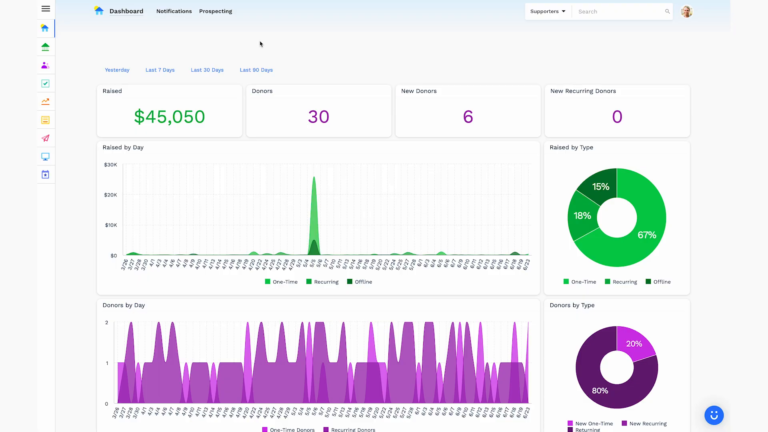
Dashboards for Nonprofits: The 4 Reports Every Team Needs (With Real Examples)
See 4 real nonprofit dashboard examples, from donor retention to sustainer MRR to campaign attribution, plus the KPIs every team should track and how to build your own.
Benefits of Monthly Digital Marketing Maintenance Services for NGOs
Why "Set It and Forget It" No Longer Works Let's be honest. A lot of nonprofits treat digital marketing like a seasonal chore: sprint around GivingTuesday, overhaul the website every few years, refresh the email template only when open rates crater. Sound familiar? The problem is that donor behavior, platform algorithms, and device trends shift…
Best Nonprofit CRMs to Integrate With Your Email, Website, and Payment Stack
Fragmented tools have a sneaky way of quietly draining your nonprofit's capacity. When your email platform doesn't talk to your CRM, your website forms dump data into a spreadsheet, and payment receipts live in a completely separate system, you're not just losing efficiency. You're losing donors, and probably some of your sanity along the way.…