
Not every nonprofit has a massive marketing budget, and honestly, that’s okay. Email remains one of the most powerful (and affordable) ways to stay connected with your supporters, but there’s a catch: sending the same generic monthly update to everyone on your list isn’t really a strategy. It’s more like shouting into a hallway and hoping someone listens.
So let’s dig into something more intentional. In this post, we’re walking through 12 types of newsletters you can send for free, each designed for a different moment in your supporter’s journey. By the end, you’ll have a clearer sense of which formats fit your goals, plus a ready-to-use AI prompt to help you build your editorial calendar without starting from scratch.
1. Impact Update Newsletters
This is the newsletter your donors have been quietly waiting for. Share tangible results tied directly to their gifts, something like: “Your donation helped 50 families access clean water last month.” Pair the numbers with a photo or a short quote from a beneficiary. These emails regularly outperform many for-profit sectors in open rates (NPTech for Good), which tells you something about how much supporters actually want this kind of transparency.
Protip: don’t bury the lead. Put the result right in your subject line, then unpack the story in the body. Organizations that consistently tie gifts to outcomes tend to see stronger recurring revenue growth, and platforms like Funraise are built to support exactly that kind of follow-through.
2. Monthly Progress Reports
Think campaign thermometers, goal percentages, and honest status updates. Something like: “We’re 75% to our Q1 target, and that’s because of you.” This format works because monthly newsletters are already a familiar rhythm for supporters (NPTech for Good), so you’re not asking them to adjust to anything new. You’re just showing up with something worth reading.
3. Volunteer Spotlights and 4. Community Spotlights: A Two-for-One
These two formats serve a shared purpose: celebrating the people who power your mission. The angle is where they differ.
Volunteer Spotlights profile specific individuals. “Meet Sarah, who logged 100 hours sorting donations this quarter.” Include a call for new sign-ups. These newsletters have a surprisingly strong track record of converting volunteers into donors (Beehiiv).
Community Spotlights flip the mic to your audience. Feature supporter-submitted photos from events, user stories, or social media shoutouts. It builds a sense of ownership and belonging that’s hard to manufacture any other way.
Protip: use your bulk email tool to poll your list for spotlight submissions. Even a small response rate from a list of a few thousand contacts (NPTech for Good) gives you a steady pipeline of authentic content without having to chase it down yourself.
5. Event Invitation Series
A single event email is easy to ignore. A sequenced series is not. Here’s one approach that tends to work well:
| Newsletter in Series | Purpose | Example CTA |
|---|---|---|
| Save-the-Date | Build awareness early | “Mark Your Calendar” |
| Reminder | Drive registration | “Secure Your Spot” |
| Post-Event Recap | Close the loop | “See the Impact You Made” |
This works for galas, webinars, peer-to-peer kickoffs, and community meetups alike. And if you embed registration or donation forms directly into those emails, you remove friction entirely. Funraise forms report a 50% donation conversion rate on interacted forms (Funraise), which is a number worth paying attention to.
6. Donor Welcome Series
First impressions matter, and here’s the thing: when someone makes their first gift or signs up, the worst follow-up you can send is another ask. Instead, consider a short sequence: a mission introduction, a quick impact teaser, and a low-stakes engagement step like “Reply to this email and tell us what drew you to our cause.”
Protip: automate this series so it fires the moment a new supporter enters your CRM. If you’re using an all-in-one platform like Funraise, this kind of automation is already built in and free to start.
7. Behind-the-Scenes Glimpses
“A day in our soup kitchen.” “What actually happens to donations between Tuesday and Friday.” This type of newsletter humanizes your organization by pulling back the curtain on daily operations, staff routines, or program logistics. It deepens emotional connection without requiring a production budget (Bloomerang). Sometimes the most compelling content is just honest.
8. Quick Action Alerts
Not every newsletter needs to be a saga. Sometimes the most effective email is two sentences and a button: “Sign this petition in 2 minutes” or “Share this post to help us reach 10,000 people by Friday.” Low-commitment asks like these mobilize advocates fast and keep your list warm between bigger campaigns (Givebutter).
Protip: keep these under 100 words. The constraint forces clarity, and that’s usually what drives higher click-through rates.
Ready-to-Use AI Prompt: Plan Your Newsletter Calendar
Before you build all 12 types from scratch, let an AI assistant handle the heavy lifting on your editorial calendar. Copy the prompt below and paste it into ChatGPT, Claude, Gemini, or whichever model you already have open:
Act as a nonprofit communications strategist. I run a [TYPE OF NONPROFIT] with [NUMBER] email subscribers. Our top 3 goals for the next quarter are [LIST GOALS]. Using all-in-one fundraising software for nonprofits like Funraise.org for email sends and donor segmentation, draft a 3-month newsletter calendar that rotates through at least 6 different newsletter types (impact updates, event invitations, volunteer spotlights, action alerts, behind-the-scenes, and success stories). For each send, suggest a subject line, primary CTA, and the donor segment it should target. Format the output as a table organized by week.It’s also worth leaning on tools like Funraise that have AI components built directly into the platform where you’re already managing donors and campaigns. Full operational context, no tab-switching required.
9. Success Story Testimonials
Curate beneficiary narratives paired with concrete stats: “Because of supporters like you, John completed his GED and secured full-time employment within six months.” Testimonial-driven emails are a meaningful driver of click-through performance across the nonprofit sector (NPTech for Good).
Protip: segment your list by giving history before you send. Lapsed donors respond measurably better to personalized stories delivered through automated workflows, and Funraise’s segmentation tools make that doable even on the free tier.
10. Tech Tips for Supporters
This one is underused, and that’s a shame because it’s surprisingly effective. Share a free tool or simple trick your supporters can use to amplify their impact: “Here’s how to set up a peer-to-peer fundraising page in under 5 minutes” or “Use this free AI tool to write your personal fundraising appeal.” It ties naturally to what we’re doing here at eriders.net, which is helping nonprofits bridge the gap between complex technology and their daily mission work.
11. Seasonal Gratitude Roundups
Year-end and holiday thank-you emails are standard. What makes them actually land is personalization: “Here’s your 2025 impact summary.” Show each donor their total giving, the programs they supported, and the collective result. With nonprofit donor retention sitting lower than most organizations would like (Funraise), a well-crafted gratitude email can be the nudge that turns a one-time giver into a recurring one. Small effort, real payoff.
12. Future Vision Teasers
Give supporters a reason to stay invested. Sneak peeks at upcoming projects (“Next year we’re expanding to three new cities”) or strategic priorities create genuine anticipation and signal that your organization is healthy and moving forward. This is the newsletter that shifts donors from transactional to long-term partners.
Common Challenges We See Every Day
The gap between “knowing what to do” and “actually doing it” is real. Here are three patterns that come up again and again:
- The “one newsletter fits all” trap. Organizations send the same generic update to every contact, whether they donated yesterday or three years ago. Segmentation feels complicated, so it gets skipped entirely.
- Manual welcome emails that never get sent. The team knows first impressions matter, but without automation, new donor onboarding falls to whoever remembers, which is often nobody during a busy campaign.
- No visibility into what’s working. Teams send emails but never check open rates, click-throughs, or conversion data because reporting lives in a separate tool they rarely log into.
These are solvable problems. Platforms like Funraise consolidate sending, segmentation, and reporting in one place, and you can start for free with no commitment to test whether it fits your workflow.
“The nonprofits that grow fastest aren’t the ones sending more emails. They’re the ones sending the right email to the right supporter at the right moment. That’s a technology problem, not a content problem.”
Funraise CEO Justin Wheeler
Putting It All Together
You don’t need to launch all 12 types next week. Start with two or three that align with your current goals, build templates, and expand as you learn what resonates. And before you hit send on anything, check how it looks on your phone. Around 45-50% of email opens happen on mobile (Stripo Email), so what looks great on a desktop can fall apart on a smaller screen.
The opportunity in nonprofit email isn’t in sending more. It’s in sending smarter. And with free tiers available on platforms like Funraise, the barrier to entry is basically zero. The only real cost is deciding to start.
About the Author

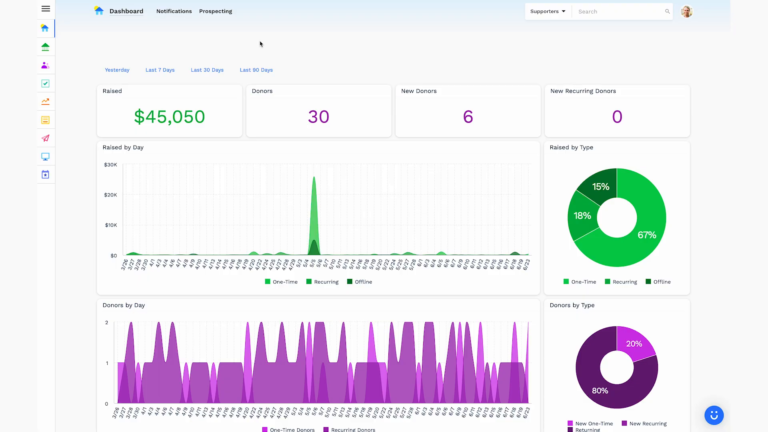
Dashboards for Nonprofits: The 4 Reports Every Team Needs (With Real Examples)
See 4 real nonprofit dashboard examples, from donor retention to sustainer MRR to campaign attribution, plus the KPIs every team should track and how to build your own.

Benefits of Monthly Digital Marketing Maintenance Services for NGOs
Why "Set It and Forget It" No Longer Works Let's be honest. A lot of nonprofits treat digital marketing like a seasonal chore: sprint around GivingTuesday, overhaul the website every few years, refresh the email template only when open rates crater. Sound familiar? The problem is that donor behavior, platform algorithms, and device trends shift…

Fundraising Gala Tech Stack: Auction, Check-In, and Payment Tools Compared
Fundraising galas have come a long way. We're not talking about the old days of paper bid sheets and hand-written guest lists anymore. Today's events run on connected technology that ties together your auction, your check-in flow, and your payment processing into something that actually feels smooth, for your guests and your team. And yet,…