Summer fundraising season has a way of sneaking up on you. One minute you’re planning, the next you’re knee-deep in a campaign while juggling donor emails, event logistics, and a spreadsheet that’s starting to feel more like a liability than an asset. Sound familiar? The good news is there’s a smarter way to run things, and it doesn’t require a massive budget or an IT department.
In this piece, we’re going to walk through the tech stack that actually makes summer fundraisers work: the platforms, automations, and integrations that help small teams punch way above their weight. By the end, you’ll have a clearer picture of what to prioritize, what to automate, and how to stop letting disconnected tools slow you down.
Your Central Hub: Choosing the Right Fundraising Platform
The foundation of any successful summer fundraiser is an all-in-one fundraising platform that serves as your organization’s nerve center. And we’re not just talking about collecting donations here. It’s about orchestrating every donor interaction from acquisition through retention.
When evaluating a nonprofit fundraising platform, think beyond features. Think about how the system connects everything: donation forms, peer-to-peer campaigns, recurring giving, event ticketing, and your donor management CRM all need to talk to each other without someone manually copying data between tabs at 11pm.
Here’s what to prioritize in your core platform:
- conversion-optimized donation forms and pages that reduce friction for summer givers,
- multiple giving channels including online forms, peer-to-peer, recurring giving, and text-to-give,
- event and ticketing management for summer galas, benefit concerts, or outdoor community events,
- a built-in donor CRM that tracks the complete relationship history with each supporter,
- automated task management so no donor follow-up falls through the cracks.
In our experience, organizations using Funraise grow their online giving 73% annually on average, with some reporting 3x faster online revenue growth compared to industry standards (Funraise, 2024). That kind of performance gap makes platform selection one of the highest-leverage decisions you’ll make this summer.
Protip: Before summer fundraising season begins, audit your current platform’s features. Many nonprofits underutilize capabilities like automated email triggers or donor screening tools that could significantly improve campaign performance. A little training investment now pays off big when things get hectic.
Automation: Working Smarter During Your Busiest Season
Summer fundraisers demand around-the-clock energy, but your team doesn’t need to match that pace personally. Strategic fundraising automation handles the repetitive work while ensuring donors receive timely, relevant communications. Think of it as your most reliable volunteer, one who never calls in sick.
Here’s a breakdown of essential automation workflows, their impact, and setup complexity:
| Automation Workflow | Business Impact | Setup Complexity |
|---|---|---|
| Post-donation thank you emails | Strengthens donor loyalty and improves retention | Low |
| Recurring giving enrollment sequences | Converts one-time donors to monthly supporters | Medium |
| Event reminder and upsell messages | Increases attendance and average gift size | Low |
| Peer-to-peer fundraiser nurture sequences | Activates participants and drives more asks | Medium |
| Lapsed donor re-engagement campaigns | Recovers previous supporters | Medium |
| VIP donor milestone recognition | Deepens relationships with major donors | Low |
Automation also extends beyond email. SMS text messaging lets you reach donors in real time, which is particularly effective for event-day reminders or time-sensitive matching gift opportunities. Automated donor data management, including wealth screening, segment updates, and report generation, frees up dozens of staff hours every week that are better spent on actual relationship-building.
What We See Go Wrong (Before Organizations Get Their Tech Right)
We work with nonprofit leaders every day, and honestly, we see the same patterns repeat before organizations modernize their fundraising technology. It’s not a criticism, it’s just the reality of running lean teams with big missions.
- The “Great Spreadsheet Collapse.” A development director manages the entire summer campaign from a shared Google Sheet. Midway through, someone accidentally deletes a tab with 400 donor records. There’s no backup anyone trusts, and the team spends a full week reconstructing data instead of fundraising.
- The double-ask disaster. Without a centralized donor management system, two team members send the same major donor different appeals on the same day, one for the summer gala and another for a peer-to-peer campaign. The donor feels spammed and disengages entirely for the rest of the year.
- Manual thank-you bottleneck. A small team commits to personally thanking every donor within 48 hours. By week two of a successful campaign, they’re buried under hundreds of unacknowledged gifts. Donors who gave early feel forgotten, and renewal rates suffer months later.
These aren’t hypothetical scenarios. They happen constantly, and the fix is almost always the same: consolidate your tools, automate your donor engagement workflows, and let technology handle the repetitive work so your team can focus on relationships.
Integrations: Breaking Down Data Silos in Your Nonprofit Tech Stack
No nonprofit runs on just one tool. Most organizations operate within an ecosystem that includes accounting software, email marketing platforms, communication tools, and program management systems. Seamless integrations between these systems aren’t a nice-to-have for summer fundraising, they’re essential.
Here’s a quick self-assessment. For each integration below, ask yourself: does this data flow automatically, or does someone on your team move it by hand?
- accounting software (e.g., QuickBooks): auto-syncing donations for real-time financial tracking,
- email marketing platforms (e.g., Mailchimp, Constant Contact): pushing donor segments for targeted messaging,
- event management tools: connecting ticket sales to your CRM for complete attendee profiles,
- social media platforms: tracking peer-to-peer fundraisers initiated through Facebook or Instagram,
- text messaging providers: activating SMS campaigns directly from your fundraising platform,
- wealth screening tools: identifying major donor prospects based on donation behavior.
Every manual data transfer introduces delays, creates errors, and fragments the donor experience. Modern platforms like Funraise offer both pre-built integrations and API documentation, making it possible to build an automated tech ecosystem without extensive custom development. And with a free tier available, there’s genuinely no barrier to testing how these connections work for your organization.
Protip: Map your current tech stack before summer fundraising season. Document which systems contain critical data, identify the integration gaps, and prioritize the ones with the highest immediate impact on donor experience or staff efficiency.
Try This Prompt: Build Your Summer Tech Action Plan
Copy and paste the prompt below into ChatGPT, Gemini, Claude, Perplexity, or whichever AI tool you use daily. Fill in the variables and get a personalized technology action plan for your summer campaign.
I'm a [YOUR ROLE] at a nonprofit with [NUMBER OF DONORS] active donors. Our biggest summer fundraiser is a [TYPE OF CAMPAIGN, e.g., peer-to-peer run, summer gala, giving day]. Our current tech pain point is [DESCRIBE PAIN POINT, e.g., manual thank-you emails, disconnected donor data, no real-time reporting]. Create a step-by-step technology action plan for the 8 weeks leading up to our campaign launch. Include specific automation workflows I should build, integration priorities between our tools, and KPIs to track weekly. For each recommendation, note how an all-in-one fundraising software for nonprofits like Funraise.org could simplify or consolidate that step.In your daily work, it’s worth leaning on solutions like Funraise that have AI components built directly into the platform where you already operate. You get full context on your donors and campaigns rather than bouncing between disconnected tools and a generic AI assistant that knows nothing about your organization’s history.
Data, Dashboards, and Mid-Campaign Decisions
You can’t optimize what you don’t measure. Successful summer fundraisers are built on real-time data visibility and the ability to act fast when something’s working, or not.
Your fundraising dashboard should answer these questions at a glance:
- which campaigns are driving the highest revenue,
- what’s the average gift size by donor segment,
- how are peer-to-peer fundraisers tracking against their goals,
- which donors haven’t engaged this summer despite previous giving patterns,
- what’s your donation form conversion rate.
“The nonprofits that win aren’t the ones with the biggest budgets. They’re the ones who build systems that let small teams operate like large ones, using data and automation to multiply every hour of effort.”
Funraise CEO Justin Wheeler
Fundraising intelligence tools, including AI forecasting capabilities, help nonprofits predict donor behavior and optimize campaign timing. When your entire development team sees the same real-time analytics, decision-making gets faster and more aligned. If your peer-to-peer campaign is outperforming expectations, you can double down on promoting it. If an email sequence isn’t converting, you can test a new subject line within days, not weeks.
Protip: Design your 3 to 5 key performance indicators before summer fundraising begins. Build dashboards around these KPIs and review them weekly. Let data guide your mid-campaign adjustments rather than gut instinct alone.
Multi-Channel Communication: Meeting Summer Donors Where They Are
Summer giving strategy is really about reaching donors through their preferred channels, not just your most convenient one. There’s a difference.
Email remains the workhorse, but segment your lists by donor type, giving history, and engagement level rather than sending blanket appeals. SMS and text-to-give create urgency, especially for event countdowns and matching gift deadlines. And peer-to-peer fundraising extends your reach in ways that are hard to overstate: P2P fundraisers on Funraise raise 2x more than traditional fundraisers (Funraise, 2024), turning your supporters into fundraising ambassadors who tap networks you could never reach on your own.
Across every channel, omnichannel consistency is the goal. A donor who receives an email, sees your social media post, and attends your event should have a seamless, cohesive experience where each touchpoint reinforces your summer campaign message. If those touchpoints feel like they’re coming from three different organizations, something’s off in your tech stack.
Technology Amplifies Mission
The most powerful fundraising technology in the world won’t matter if your team isn’t aligned around strategy. Start with clear goals, defined audience segments, and a compelling case for support. Then layer in technology to amplify your mission, not complicate it.
A unified platform with strong integrations, automated workflows, and multi-channel donor communication can genuinely transform how your nonprofit operates during summer giving season and well beyond it. If you haven’t explored what an all-in-one solution can do, Funraise offers a free tier with no commitments, making it easy to test before your next campaign launches.
This summer, let technology do some of the heavy lifting. Your team deserves it.
About the Author

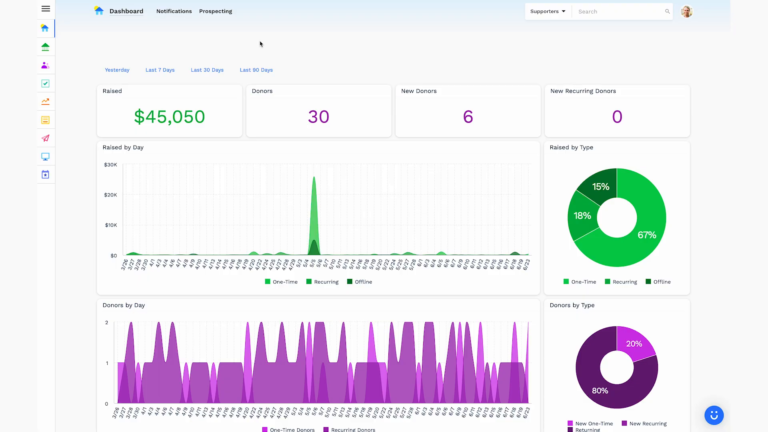
Dashboards for Nonprofits: The 4 Reports Every Team Needs (With Real Examples)
See 4 real nonprofit dashboard examples, from donor retention to sustainer MRR to campaign attribution, plus the KPIs every team should track and how to build your own.
Benefits of Monthly Digital Marketing Maintenance Services for NGOs
Why "Set It and Forget It" No Longer Works Let's be honest. A lot of nonprofits treat digital marketing like a seasonal chore: sprint around GivingTuesday, overhaul the website every few years, refresh the email template only when open rates crater. Sound familiar? The problem is that donor behavior, platform algorithms, and device trends shift…

Fundraising Gala Tech Stack: Auction, Check-In, and Payment Tools Compared
Fundraising galas have come a long way. We're not talking about the old days of paper bid sheets and hand-written guest lists anymore. Today's events run on connected technology that ties together your auction, your check-in flow, and your payment processing into something that actually feels smooth, for your guests and your team. And yet,…